
Project Triangle
The Project Triangle (a.k.a. the Iron Triangle or Triple Constraint) is the idea that every project is governed by three competing constraints — Scope, Time, and Cost — and that you can't optimise all three simultaneously. Move one, and at least one of the others will shift in response.
It's one of the oldest and most battle-tested mental models in project management, and it applies just as cleanly to software delivery as it does to construction or manufacturing.
The Three Constraints
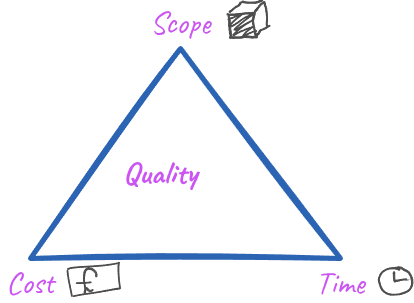
| Constraint | What it covers |
|---|---|
| Scope | Features, quality, and deliverables — what you're actually building |
| Time | Deadlines, sprint cadence, release windows |
| Cost | Budget, headcount, tooling, infrastructure |
The folk wisdom version: "Fast, cheap, or good — pick two."
How the Trade-offs Play Out
The triangle doesn't say you can only have one constraint. It says you can fix any two, and the third becomes the variable. In practice, there are three common patterns:
Fix Time + Cost → Scope flexes
This is arguably the most sensible default in agile software delivery. You have a team of a fixed size (cost) and a release date (time) — scope becomes what you negotiate. MoSCoW prioritisation, MVP thinking, and iterative delivery all live in this quadrant.
Example: A product team has a quarter to ship a new checkout flow with a team of four. They lock time and cost, and scope the work down to the must-haves — payment processing and order confirmation. Wishlists and personalisation go to the next cycle.
Fix Time + Scope → Cost flexes
You need a specific set of features by a fixed deadline, and you'll spend what it takes to get there. This can mean hiring contractors, buying off-the-shelf solutions, or paying for overtime. It's expensive, often unsustainable, and usually a sign of poor earlier planning — but sometimes genuinely necessary (regulatory deadlines, market windows).
Example: A fintech startup must comply with new open banking regulation by Q3 or face fines. Scope (the API surface) and time (the deadline) are non-negotiable, so they bring in two specialist contractors to accelerate.
Fix Cost + Scope → Time flexes
A fixed budget and a fixed feature set means the timeline stretches until the work is done. Common in bootstrapped startups or internal tooling projects where there's no hard deadline. The risk is that timelines slip indefinitely without active management.
Example: A small engineering team builds an internal analytics dashboard. Budget is capped and the full feature set is needed, so the release date shifts from Q1 to Q2 to Q3 as the team absorbs other priorities.
Why CTOs Should Care
The triangle is most valuable not as a theoretical model but as a conversation tool. Most delivery conflicts happen because different stakeholders are implicitly optimising for different constraints without saying so out loud.
A few situations where the triangle is particularly useful:
1. Managing executive expectations When a business leader says "we need it faster and we can't spend more", the triangle gives you a structured way to respond: "OK, what are we cutting from scope?" It depersonalises the conversation — the constraint is a property of the project, not a negotiating position.
2. Diagnosing scope creep Scope creep is almost always the result of teams accepting new scope without adjusting time or cost. Making the triangle explicit helps teams push back: "Adding that feature means either pushing the deadline or adding capacity — which do you want?"
3. Cutting through estimation debates When stakeholders want a project "scoped out" with a fixed date and fixed cost, the triangle flags that as high-risk. You're committing all three variables without room to flex. Either you've over-estimated extensively (wasteful) or you're going to miss at least one constraint (likely).
4. Designing delivery models Agile's fixed-time-and-cost, variable-scope model is essentially the triangle institutionalised into a delivery process. Understanding the underlying principle helps leaders choose the right model for each type of project.
Common Pitfalls
- Trying to fix all three. Committing to a fixed date, fixed team, and fixed scope simultaneously is a recipe for overruns, quality debt, or burnout. One constraint must breathe.
- Ignoring quality as a dimension. Some versions of the triangle replace "cost" with "quality" — or treat quality as a fourth dimension. Don't let time or cost pressure compress quality silently; make it explicit.
- Using it as a crutch. The triangle describes constraints, not solutions. "We can't do it faster" is only useful if it's followed by "so here's what we can do."
Explore Next
- RAID Log — A structured way to track the risks and constraints that feed into triangle trade-offs.
- Prioritisation — Frameworks for deciding what gets cut when scope, time, or cost must give.
- Brooks' Law — Why adding people to fix a time overrun often makes things worse.
- Analysis Paralysis — How to keep triple-constraint conversations from stalling decision-making.
References
- Project Triangle — WikipediaWikipedia — History and academic framing of the Iron Triangle model