
Communication Complexity
Why Small Teams Scale Better
As the number of participants in a system increases, the complexity of communication grows exponentially. This is because the number of possible channels between individuals follows the formula:
Where C is the number of communication channels, and N is the number of participants. Mathematically, this system is modelled as a complete graphWikipedia () in graph theory, where every vertex (person) is directly connected by an edge (communication line) to every other vertex.
Interactive Calculator
Plug in a team size to see the communication lines grow. Adjust using the inputs or quick presets.
C = 5 × (5 - 1) / 2 = 10Initially, with just a few members, direct interactions are manageable. However, as more participants are added, maintaining clarity, consistency, and efficiency in communication becomes increasingly difficult. Key challenges that arise include:
- Information Overload: More connections mean more messages, increasing the risk of misalignment.
- Coordination Overhead: Ensuring everyone remains synchronized requires additional effort, leading to bottlenecks.
- Decision-Making Delays: As input sources multiply, achieving consensus or clarity takes longer.
- Scaling Strategies: To counteract this complexity, structured approaches such as hierarchical communication, tooling (e.g., documentation, async updates), and defined protocols are essential.
Failure to manage these channels effectively leads to inefficiencies, duplicated efforts, and a loss of agility. Hence, strategic communication models are critical for scaling efficiently.
Examples of Communication Growth
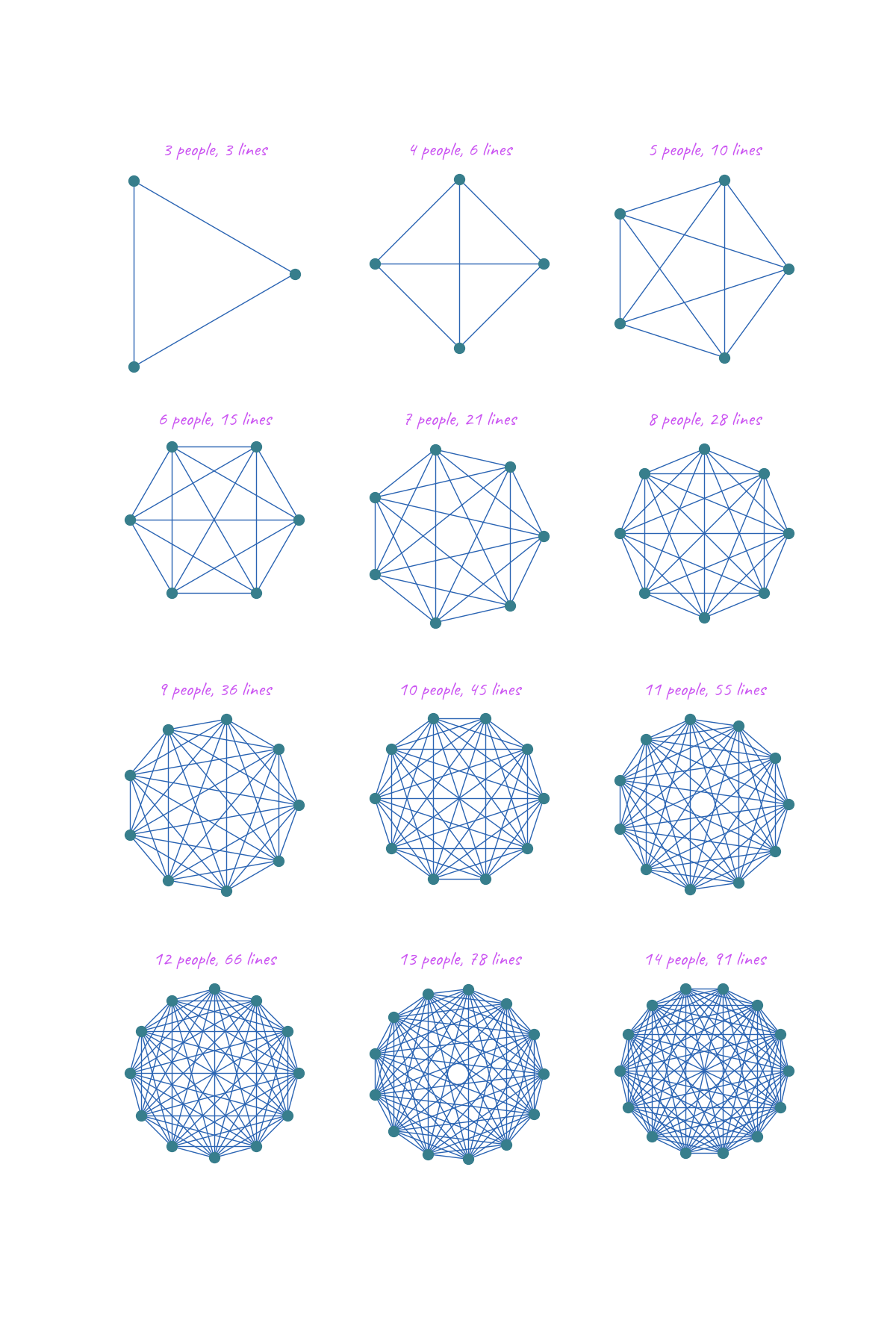
| Team Size (N) | Channels (C) | Communication Dynamics & Challenges | Strategic Recommendations |
|---|---|---|---|
| 3 | 3 | Direct interactions are easy, but information must be repeated consistently to avoid misalignment (A↔B, A↔C, B↔C). | Keep updates simple; sync regularly. |
| 4 | 6 | Ad-hoc alignment starts taking longer; direct updates require deliberate effort to keep everyone informed. | Document key decisions briefly. |
| 5 | 10 | Information silos begin to form. Some team members rely on second-hand updates, increasing miscommunication risk. | Start defining light processes and shared channels. |
| 6 | 15 | Meetings become harder to schedule; side conversations lead to fragmented understanding. | Adopt asynchronous communication (docs, status updates). |
| 7 | 21 | Decision-making slows down significantly; alignment requires structured processes. | Establish a single source of truth (project trackers). |
| 8+ | 28+ | Direct peer-to-peer communication is no longer practical. Fragmented channels dominate. | Introduce hierarchies, designated leads, or cross-functional meetings. |
Key Takeaways
- Exponential Growth: Communication complexity doesn’t scale linearly—it explodes as the team grows.
- Risk of Inefficiency: Without structure, misalignment and delays become inevitable.
- Scaling Strategies: Tools (docs, async updates), defined roles, and structured processes become essential beyond a certain team size.